OK, Cornell Woolrich is my favourite crime writer and
i guess that's obvious for anyone that has read this my Film Noir and
Pulp
Fiction page and you can read a lot about his writings and his films
here. If i have to choose a favourite novel of his this one could
well be it because of the pitch-black darkness and desperation and melodramatic
romance and love. Elements combined that makes
this novel to be maybe his most depressing, hopeless, disturbing and
dark EVER but also his most poetic and beautiful.
Not so well known perhaps but an absolute MASTERPIECE of writing.
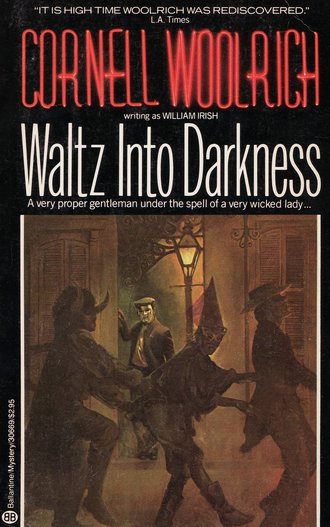
Waltz into Darkness was originally
published by Lippincott in 1947 under his pseudonym William Irish. The
Ballantine pocket book
(pic above) published in 1983 was the first unedited version since 1947.
In Sweden it was published by Centrum in 1947 under the
title "Ljuva Bonny - Farliga Bonny", a bad titlewithout the
dark poetry of the original title, the essence of Woolrich writing.
Woolrich lover, frenchman Francois Truffaut
had already the year before, in 1968, made the first filmatization of
The Bride Wore Black
with Jeanne Moreau as the female avenger (read more about this film
and novel on my Film Noir & Pulp Fiction page), and in 1969
he directed his version of the 1947 melodrama-crime novel Waltz into
Darkness.
The novel takes place in 1880's New Orleans and tells the story about
rich businessman, the 37 year old Lou Durand and his marriage
to personals-bride Julia Russel and the novel is filled to the brim
with desperation, erotic obsession, hopeless masochistic love and
tons of darkness in a powerful romantic noir melodrama that may bite
you.
It successfully summarizes Cornell Woolrich, the ultimate writer of
Noir, pessimistic view on Love and it's hopelessness.
 US
1946 Popular Library pocket book edition of the 1945 original. Cover
art by Baryé Pihilips
US
1946 Popular Library pocket book edition of the 1945 original. Cover
art by Baryé Pihilips
Perhaps Woolrich had been inspired by Vera "Laura"
Caspary's fine but forgotten 1945 melodrama noir novel Bedelia?
This novel also
depicts a hopeless relation with a beautiful but psychopathic Femme
Fatale. Darkness and desperate love if not on the Woolrich level.
Bedelia was filmed in the UK in 1946 (read more about this OK B movie
on my Film Noir & Pulp Fiction page)
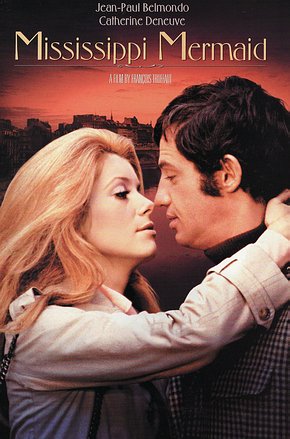
Truffaut's 1969 film version of Waltz into Darkness
was a flop, but i like it better than his 1968 La Mariée
était en noir (The Bride wore
Black). He re-named it Mississippi Mermaid and moved
the location from New Orleans to the French isle of Reunion situated
close to
Madagaskar outside of Africa. Just like his La Mariée était
en noir, Mississippi Mermaid lacks the archetypical shadows, the desperation
and the romantic pulse of Woolrich and Film Noir of the 1940's, BUT
Truffaut still succeeds in making his own interesting and somewhat
lighter version of it and also with homage to directors like Jean Renoir
and Alfred Hitchcock.
And, the sexual, erotic obsession that's something our fine Frenchman
knows about for sure.
Mississippi Mermaid starts with voices from Personal
ads and with a zooming-in on the map of the French isle of Reunion,
a French
overseas department, and of the city Saint-Denis, where we meet the
rich factory owner Louis Mahé (Jean-Paul Belmondo).
He's merrily on his way to the harbor where he will meet his personal
ads wife Julie Roussel, arriving from a long boat trip from New
Caledonia (another French overseas department). The problem is that
Julie doesn't look anything at all like the photo she sent him with
her letters, and strangely enough she can't remember any details from
them either.
Does this worry Louis a lot? NO, maybe bacause Julie is played by Catherine
Deneuve being at her height of beauty at this time, so
all doubts are swept away. He's intoxicated by her looks. But when Julie
is gone and all his bank accounts are emptied, he hires a
private detective (Yves Drouhet) to find her, and he's pissed off and
out for revenge.
But, when he finally meets her again, on the French Riviera, she's using
the name of Marion Vergano, and .... it starts all over again
and The Waltz into Darkness can be trodden.
The film was presented in widescreen 2.35:1 with french
audio and with english subtitles, and a trailer extra