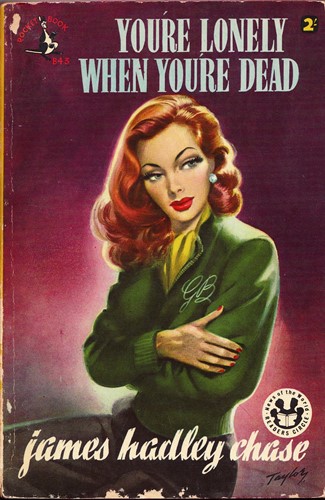
The Somewhat uneven crime maestro James Hadley Chase
(Rene Brabazon Raymond 1906-1985), the quality of his
novels differed wildly, was a HUGELY popular crime writer from the hard-boiled
school of Noir Pulp Fiction.
Strangely enough he was a Brit even though his style was very american
and his stories mostly took place in the US,
and then often in made up cities as i.a. Orchid City. Chase often imitated
the popular american pulp fiction style and
sometimes borrowed plot devices. He wasn't big in the US, who had their
own masters in the genre - but in the rest of
the world he was HUGE and Chase sold millions of books. He seems to
be the pulp fiction crime writer who's been
filmed the most times all over the world, in Bollywood, in France, in
Italy, in the UK etc. due to his clever plots, even
though i'm sure someone as prolific as Cornell Woolrich may be a contender
here

US Avon pocket edition from 1951
He debuted in 1939 with something of a BANG with No
Orchids for miss Blandish that made a furor with it's
hard-boiled roughness, sex and violence that hadn't been seen earlier
in the genre and this simple little novel became
one of the biggest pulp fiction sellers All Time. Chase boldly borrowed
the plot from William Faulkner's 1931
southern gangster story Sanctuary and the pocket book above has got
british actress Linden Travers on it's front.
Travers from the British 1948 ditto scandalous film version (read more
about the film a bit down on my Film Noir &
Pulp Fiction page) and as her dress is broken she's about to show one
of her boobies. That's prime Pulp Fiction bait.
As i already have said, Chase is uneven. When he's Good
he's REALLY GOOD with exciting and so delightfully
intricate plots that you get snared, hooked, and you can't put his books
away. But the quality varies a lot, from
snappily entertaining crime noir with femme fatales, dreams about making
the fast buck and doomed male loosers on
their way to an early death, to trashy and sloppily written ones. Not
surprising as the man wrote 2-3 novels a year
during his almost half-a-century long writing career and maybe, just
maybe his writing feels a bit flat, nothing extra.
OK, when was his prime period then ?
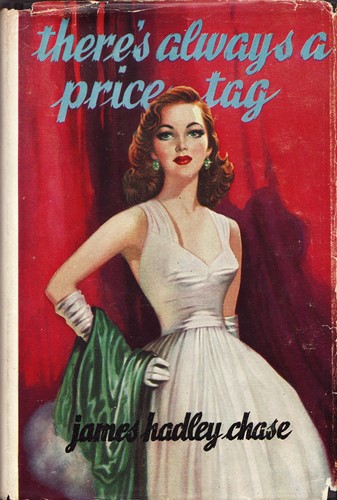
British 1956 Robert Hale original edition
At first, i liked his 1940's-1950's style best, when
his writing still had the Crime Noir feeling to it, as his There's
Always a Price Tag from 1956 (pic above). This novel's about
the classic Noir stuff, a too young Femme Fatale
wife married to a too old and rich husband with a too Fat life insurance,
and like a Siren she sings her song and
snares a young (and too horny) man to plan the perfect insurance fraud
.... Yes, there's a whole lot of Double
Indemnity here for sure, but borrowing is OK when the author does it
this good and you just can't put this book
away after start reading it.
But, with time and many more read books by Chase i've started to enjoy
his later novels even more, with their
stripped down and concentrated plots. Less violence and mayhem action
but more clever story writing with
plots working as smoothly as the finest Swiss clockworks. As in the
great An Ear to the Ground (1968) or in
the ditto Just a Matter of Time (1972) or You
Can Say That Again (1980).
With feel bad endings in the noir style, sometimes with feel good endings
and very often with Twists you didn't
see coming at you.
But why then is James Hadley Chase so underrated in
my home country Sweden ?
Answer: The Manhattan Books - A Pulp Fiction series
with low prices and with often ("cheap") alluring covers.
Well, that's what the Swedish highbrow readers and possible critics
thought, i think the early Manhattan book covers
were great, with special artists painting them. Later on the painted
covers were substituted with photos of men with
guns and semi-nude models. Some of the Pulp Fiction writers published
in the Manhattan series are today considered
to be some of the greatest writers of Crime Fiction Ever (Cornell Woolrich,
John D. MacDonald etc. etc.).
But not then, the 1950's-1970's, as the covers were thought of as "cheap"
the contents must be cheap too
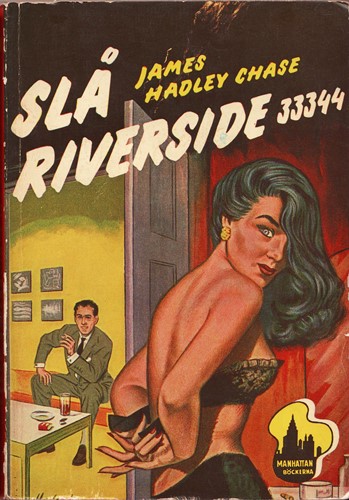
Tiger by the Tail, 1954
Chase's 38th novel in a Swedish 1956 Manhattan pocket edition
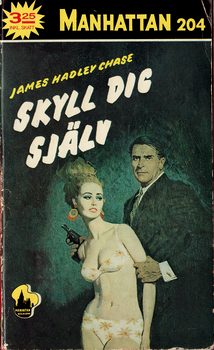
The Great 1968 An Ear to the Ground, the 68th title in a 1969 Manhattan
edition
As i already have mentioned, The US had their own Pulp
Fiction masters and where the ones who in
the 1920's - 1930's created the genre, so JHC wasn't that known there
but was Huge elsewhere in the
world. A Pulp Fiction pocket book (kioskdeckare i Sverige) couldn't
possibly be of any value with their
vulgar sleeves with half-naked women and men with guns, so the Swedish
high-brow culture mob ignored
these books. Pulp Fiction (Kioskdeckare=books bought in a kiosk, mostly
a pocket book) became a
derogatory term, even though some of the undisputedly greatest writers
of Crime Fiction from the 20th
century were published in these pocket books. Writers like Dashiel Hammett,
Cornell Woolrich, William
P. McGivern and the Florida-crime maestro John D. MacDonald etc.
Well, Sweden of course is one of the most desolate cultural deserts
in the world with the art of film and
book critic at it's nadir, the exact opposite to a great cultural country
like France.
I never forget when i read my first kioskdeckare/pulp
fiction pocket which i found in some bookcase at
home and i could've been about 20 or so. It wasn't a Manhattan book
but it had a women in a raincoat
blowing at a smoking gun and the book was The Bride Wore Black (Brud
i svart, Månadsdeckaren,
Wahlströms) by Cornell Woolrich .... and, the earth trembled under
my feet, OMG how good it was.
Mindblowing and with a haunted beautiful writing. James Hadle Chase's
writing may not carry that sort
of poetic beauty as his writing can be somewhat flat, but his plots
really lures you into their power.
For all true lovers of Crime - Pulp Fiction i do recommend that you
read some of his best novels, i do
promise that you will be surprised over how good they are